
|
|
| tracking: | |||
| az.: | ° | el.: | ° |
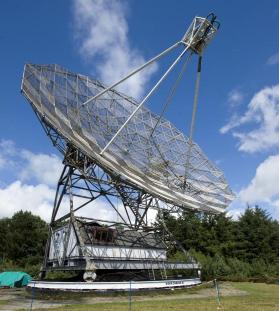
The 70cm sat and 70cm EME streams are connected to the 25m Radio Telescope.
Below the Telescope picture one can find the actual position of the beam. In case the EME group is active the Radio Telescope will track the moon. In such case you may find both 70cm and 23cm Moonbounced (EME) signals in these streams. When the group is not active the first stream will reflect the reception of the ISS and LEO satellites.
When there is no EME activity, the Radio telecope may be in its 'showstand' (showing position) (30' Elevation and 30' Azimuth),
or may be tracking astronomical objects. Occasional live terrestrial signals and even strong satellites can be heard in the side lobes of the beam even when the telescope is in the 30' 30' show position.
The other streams are generated from antennas located in the Radio Garden.
The 70cm T (terrestrial) stream is connected to a collinear antenna at 15m AGL. The stream can be used for the reception of the 430 MHz amateur radio repeaters.
The 2m, GRAVES and Aero streams are connected to a 4 element 144 MHz Yagi at 13m AGL. This antenna is facing South. Here one can receive the ISS and amateur LEO satellites. A seperate receiver shows the stream for meteor scatter reflections of the French space radar GRAVES.The other stream shows a portion of the 123 MHz air band and here gliders and the Hoogeveen Radio(EHHO) communication between the tower and aircraft can be heard.
The 4m stream is connected to a 4 element 70MHz Yagi facing South at 11m AGL. Here one can receive 4m radio amateurs.
The 6m stream is connected to a 3 element 50MHz Yagi facing South-West at 9m AGL.Here one can receive 6m radio amateurs.
The LOFAR and 8m streams are connected to a single turnstile like LOFAR LBA antenna. This antenna is oriented to the zenith. Here one can receive meteor scatter reflections of the Belgian Dourbes (BRAMS) beacon, the Belgian Ypres (IRIS) beacon and the RSGB/BAA (GB3MBA) beacon from the UK. Also 40 MHz radio amateurs can be heard on the 8m stream.
The JOVE stream is connected to the 'radio JOVE' antenna for the decametric radio emissions around 20.1 MHz of the planet Jupiter in conjunction with one of its moons Io. However most of the time, when the ionosphere is to dense, only terrestrial signals can be heard like the 15m amateur band around 21.2 MHz. The antenna is a double dipole phased array beaming South at 4.9m AGL.
The VLF stream is connected to a 'mini whip' (E-field) antenna at 1.7m AGL for the reception of very low frequencies(VLF), long wave(LW), medium wave(MW) and the 160m amateur radio band.